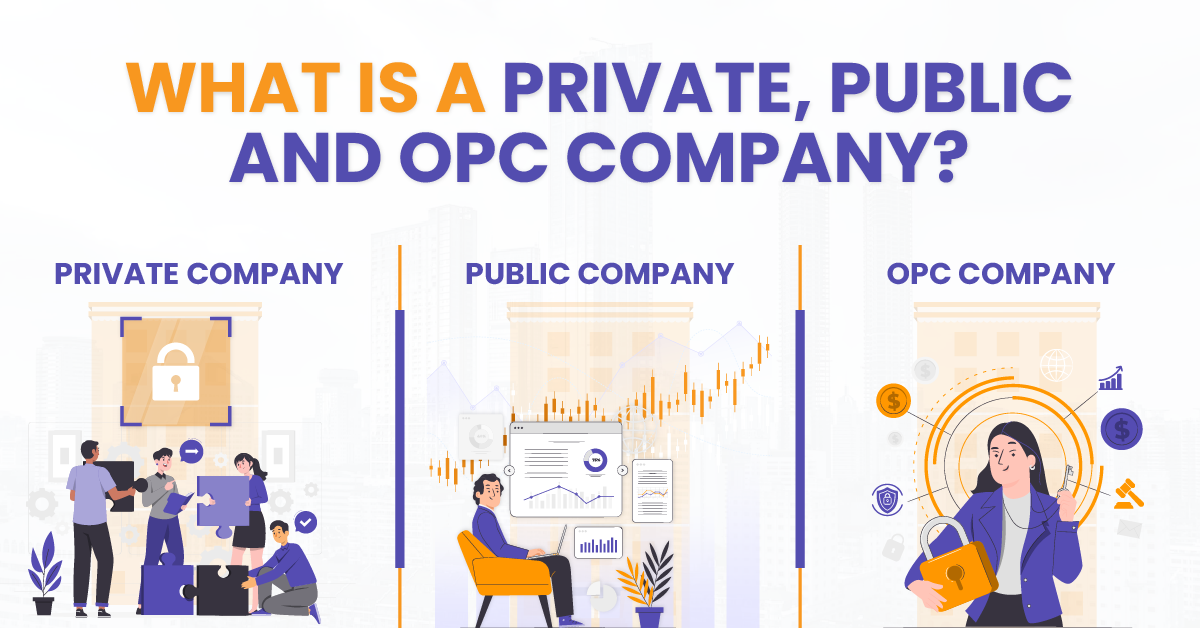
A common dilemma while starting a company is deciding the type of company. Private or Public? Or should I go for One-Person-Company (OPC)?
Well, the answer lies in the idea of the business and how you see it in the future. Let’s decode each of them so that you can make a better decision.
Whether private or public, a company can be formed as limited by shares, limited by guarantee, or unlimited company.
- Limited by shares: the liability of the members is limited to the amount unpaid on the shares held by them.
- Limited by guarantee: the liability is limited to the amount the member promises to contribute to the assets and other costs in the event of winding up.
- Unlimited company: the creditors can recover their dues from the personal assets of the members.

Private Company
A Private Company can be formed of 2 or more persons and should have a minimum of 2 directors. The shares of the private company are not freely transferable and are not publicly traded on stock exchanges. Generally, VCs and private equity firms prefer to invest in private companies and exit when the company goes public. So, this type of company has more scope to get external investments and less dilution of control. These are also suitable for fast growing family businesses to ensure a distinction between shareholders and management. A family business can decide to have all the family members as shareholders, while those who are entrusted with the responsibility to run the business can be the Directors.
Public Company
A Public Company can be formed by 7 or more people and should have a minimum of 3 directors. Public company shareholders hold shares only in demat form. The shares of a public company can be listed, and traded on the stock exchange. To list the shares, such companies and must comply with the regulations of SEBI. This type is more suitable for large-scale businesses. Often, a company starts as a private company and later goes public through an Initial Public Offer. Public companies must adhere to many more regulations as compared to private companies. Public companies can also remain unlisted but with a large number of public shareholders.
One Person Company
OPC is a type of private company that can be formed by a single person with a single director. The memorandum of OPC should state the name of a nominee who will be appointed in the event of the death of the subscriber or his or her incapacity to contract. The shares of an OPC can only be transferred by altering the memorandum of association. It follows less compliance as compared to other private companies, and the owner enjoys more control and flexibility over business decisions.
Conclusion
Choosing the ideal company depends on your plans for expansion, the amount of control you are willing to exercise and relinquish, and the type of investments you seek for your business. So, a company should be formed according to these deciding factors. You can always change the structure of the company as your business plan progresses.
Leave a Reply