Introduction
Starting a business in India, whether it’s a retail store, consulting firm, IT startup, or even a home-based online venture, comes with its share of legal responsibilities. One such registration requirement is under the Shops and Establishments Act, governed by state-specific labour laws. This regulation aims at establishing and ensuring basic welfare measures towards the employees. Let us explore more details about this regulatory framework in this blog.
What is Shops and Establishments Act?
The Shops and Establishments Act regulates working conditions in shops and commercial establishments. While each state has its own version of the law, the core intent is to establish basic employment conditions such as working hours, leave policies, wage payments, holidays, and other employee welfare measures. These laws are applicable to numerous types of commercial operations, ensuring broad coverage and compliance.
The Broad Coverage & Scope
- Registration is typically required if you are running a business, have employees (even just one), or use a dedicated workspace, irrespective of if it is rented, owned, or shared.
- The applicability is broad, covering nearly all commercial establishments except those governed by the Factories Act (as it ensures the objective of this act) and other specific exclusions or exemptions as defined by each State’s Shops and Establishments Act.
- Beyond being a legal requirement, registration under this act serves as an essential business identity, often necessary for opening bank accounts, applying for GST registration, obtaining trade licences, and accessing MSME schemes.
- Non-registration can lead to legal complications. Most state labour departments are authorized to impose fines, which may increase with continued default. In addition to monetary penalties, businesses without registration may also face difficulties in obtaining other licences and government approvals.
Registration and Compliance – Key Aspects
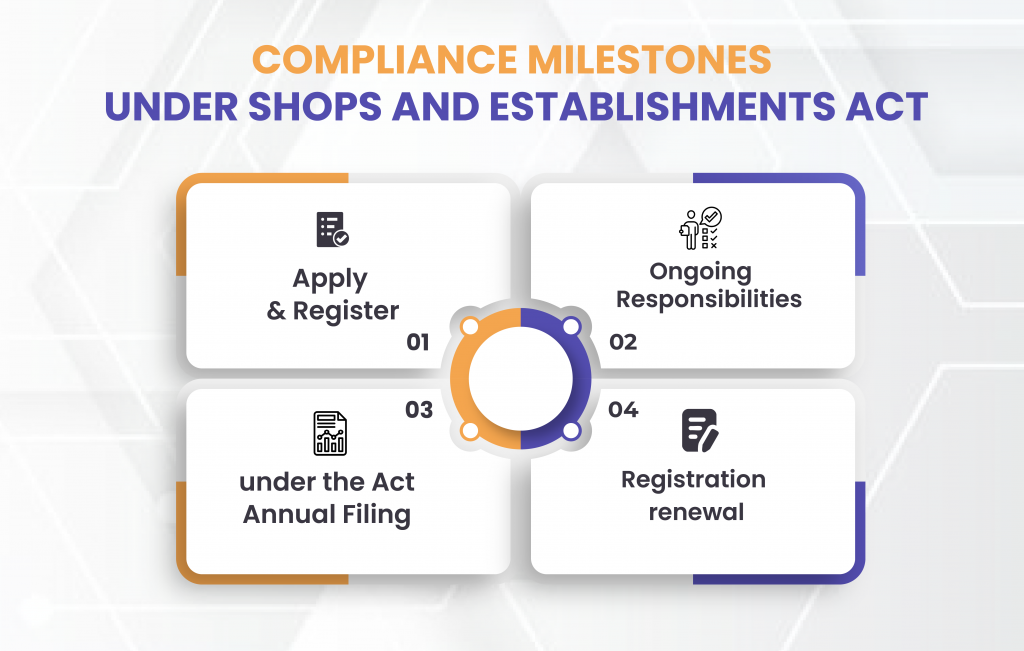
The Shops and Establishments Act registration process is digitized in most of the states, making it a smooth flow. The process begins with an online application through the respective state’s Labour Department portal, where business owners submit key details and documents and pay the prescribed fee. However, compliance does not end with registration. Such businesses are also required to adhere to annual filings, timely payment of applicable fees, and periodic renewal of the registration certificate.
The Karnataka Shops and Commercial Establishments Act, 1961, follows a similar digital process, with registration and compliance managed through the e-Karmika portal. The certificate is valid for five years, and businesses must ensure timely renewal with annual filing in Form-U by 31st January every year.
Conclusion: A Small Step Towards a Legally Sound Business
Though often overlooked, it forms a foundational part of your formal business structure. Hence, to the question, “Do I need a registration under the Shops and Establishments Act?” the answer is mostly a “Yes”!
If you are unsure where to start, consult your local labour department or reach out to us. At Advith ITeC, we guide you through the Shops and Establishments registration process and handle other essential registrations like GST, MSME, professional tax and more. Our specialists ensure that your business is fully compliant to operate from day one.
Contributors:
CA N Srilatha Bhat – LinkedIn
Kuldeep Sarma – LinkedIn
Poonam Vernekar – LinkedIn
Leave a Reply