I. Introduction
Financial decisions are deeply influenced by our financial behaviours which are shaped by habits, emotions and personal experiences. While these patterns often operate subconsciously, the good thing is that financial behaviour is not static—It can be reshaped and improved. This is where financial education plays a transformative role.
With the abundance of financial choices and evolving digital transformation, financial education has become essential and not just beneficial. From managing day-to-day expenses to choosing the right investment options, certain level of financial educationis now fundamental.
In this blog, let us explore how financial education shapes financial behaviour and why that connection is crucial for long-term financial well-being.
II. Understanding Financial Behaviours and Patterns
Financial behaviour refers to the choices, habits and decisions individuals make around money such as saving, spending, budgeting and investing shaped by personal experiences and psychological patterns. Even people with similar life paths can develop different financial behaviours, from chronic saving to impulsive overspending.
For example,
- Someone who grew up with financial hardship may develop a habit of excessive saving, sometimes even appearing miserly.
- On the other hand, others with similar backgrounds might overspend to compensate for the struggles and lack of privileges they had gone through.
This is where behavioural finance plays role, highlighting how emotions and biases often override logic in financial choices.
III. Behavioural Shift Through Financial Education
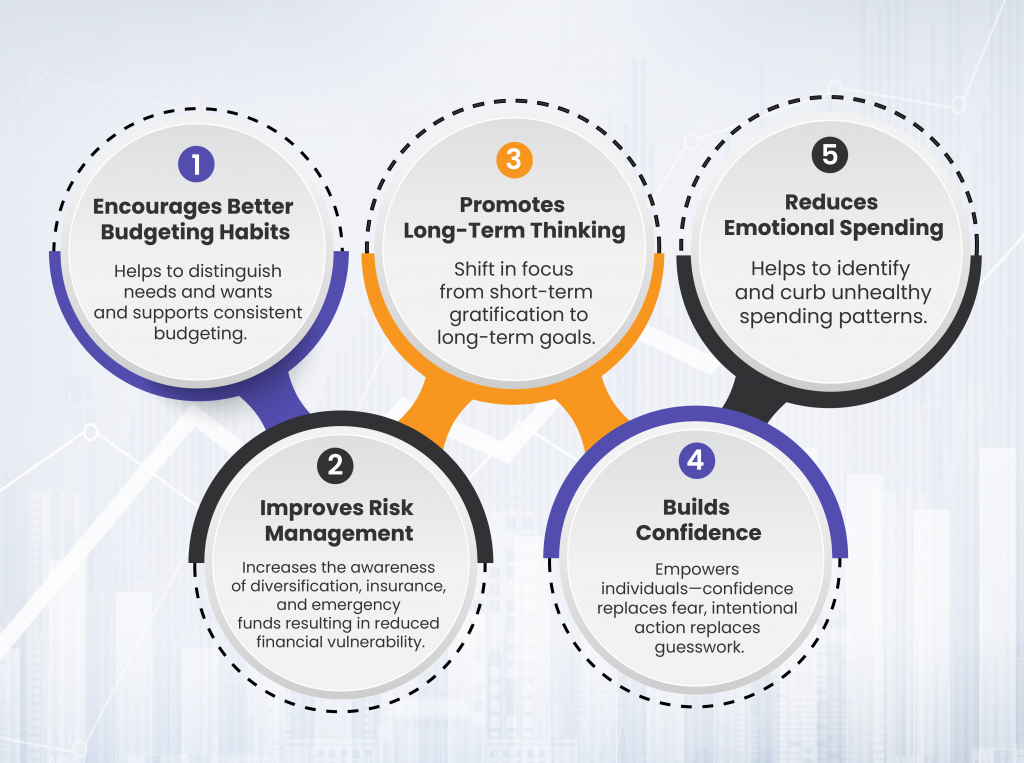
The core objective of financial education is to enable informed financial decisions. It goes beyond understanding concepts like interests, inflation or mutual funds and encourages a systematic approach towards setting budgets, financial goals, resist impulsive spendings and achieve financial stability. Financial education not only guides people to make decisions based on knowledge instead of emotion or habit, but also gradually transforms those underlying habits and emotional patterns.
IV.The Role of Professionals
Despite growing awareness, many still struggle with effective money management. That is because financial education does not end with personal effort—It thrives with professional guidance. The value of professional financial advisor is often underestimated, especially among the Small and Medium Enterprises (SMEs), startups and even individual earners. At Advith ITeC, we bridge this gap through personal finance management that is personalised, data-driven, and goal-oriented. With ongoing support and technology-enabled tools like ITeCApp, we guide individuals and businesses towards sound financial decisions.
V. Conclusion
Financial education helps us to move away from impulsive or emotional money habits and make thoughtful, goal-oriented decisions. Fintech Apps like ITeCApp play a key role by educating users on essential financial concepts and practices. Financial education is not a one-time lesson, it is a habit we build over time that shapes the way we manage money. In the end, combining the right knowledge with professional guidance is what leads to better financial behaviour.
Looking for more clarity and confidence in managing your finances? We are here to help. Download ITeCApp today and take a smart step toward better money decisions.
Contributors:
CA N Srilatha Bhat – LinkedIn
Kuldeep Sarma – LinkedIn
Poonam Vernekar – LinkedIn
Leave a Reply