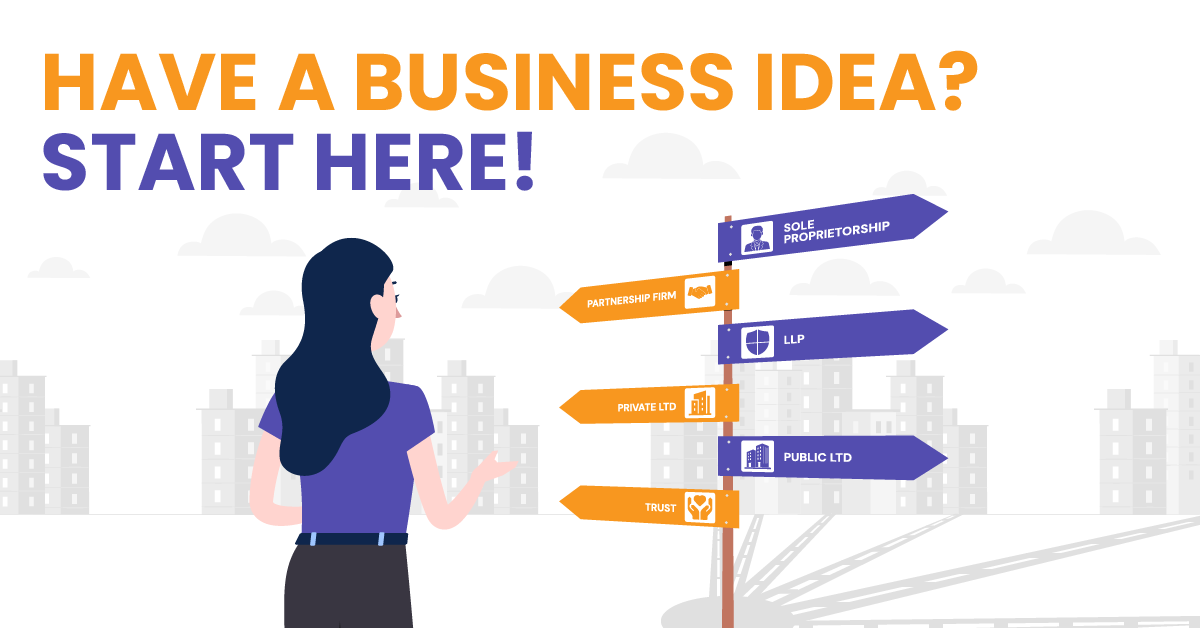
So, you have a business idea and you have set your business objectives! The main confusion right now would be where to start? Which is the most suitable structure for your business idea?
Deciding the structure of the business is important because it will define the legal expenses, compliance costs, taxes, and ease of investment.
Let’s analyze different types of entities that can be formed in India so that you can select the right one.

Sole Proprietorship
If you are a one-person army and want to start a small-scale business, then, sole proprietorship is the right answer for you.
- You enjoy full control over the business operations.
- You can set up your business with minimal paperwork and very quickly.
- Drawback of a sole proprietorship is that the owner and the business would be considered the same, and you would be personally liable for all the business liabilities.
Partnership Firm
If you want to start a business in partnership, then you should register it as a firm.
- Easy to set up with minimum paperwork.
- Every partner has unlimited liability.
- The profits and losses are divided among the partners based on the terms agreed upon in the partnership deed.
- It is not mandatory to register a partnership deed in India, but it would be advisable to do so as it confirms the legal existence of your business.
Limited Liability Partnership (LLP)
LLP is a form of entity that is a combination of a private company and a partnership firm.
- Requires at least two partners who sign an LLP agreement.
- LLPs should have two designated partners and have to apply for Designated Partner Identification Number (DPIN).
- Designated partners are responsible for compliance with the LLP Act and the penalties for non-compliance.
- The partners here have limited liability, unlike partnership firms.
- The LLP can continue its existence irrespective of changes in partners.
- It is capable of entering into contracts and holding property in its own name.
- It has fewer compliance requirements compared to a company.
Private Limited Company
A private limited company is suitable for businesses that are small and medium-sized, with the potential to grow big.
- It can be formed with a minimum of two members and two directors.
- The company must register itself on the MCA portal.
- The company must comply with the provisions of the Companies Act, 2013 for any activity like passing a resolution, holding board general meetings, etc.
- It also offers the flexibility of raising funds from investors and scaling them further.
Public Limited Companies
Public limited companies are similar to Private limited companies, however it has the option to raise capital from public at large.
- These are more suitable for large businesses, which requires raising money from public or list them on stock exchange to invite a larger number of public investors, portfolio investors and large fund houses.
- The compliances for a Public company are substantially more compared to a Private Limited Company.
Trust
Trusts are formed for the benefit of a third party. They can be either private trust or a public trust.
- A private trust is created for the benefit of certain people. For example, parents can create a trust for their children to transfer property and income. It is generally beneficial when you have a large number of assets that need to be managed.
- A public trust is created for the benefit of the general public. For example, Charitable Trusts or Religious Trusts. A Public Trust also enjoys tax exemptions, subject to certain conditions.
Conclusion
So, these are the different types of organizations that can be formed in India. An entrepreneur can choose amongst these based on the objectives and scale of your business.
Leave a Reply