Introduction
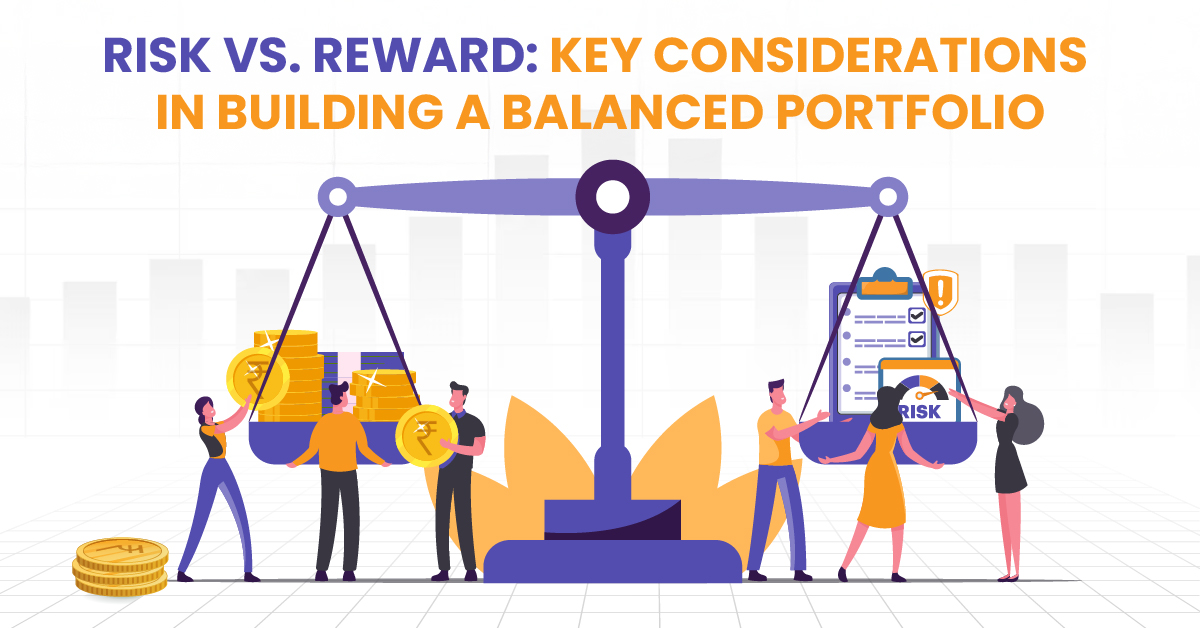
In today’s world of financial uncertainties, building a balanced investment portfolio is of paramount importance for every individual. A balanced portfolio is allocating your investments into different asset classes which aligns with your financial goals and risk appetites. Understanding the relationship between risk and reward is essential to take informed decisions in the financial path. In this blog, let us explore how risk vs reward assessments lead to a balanced investment portfolio.
Risks and Rewards: Assessment
Every investment comes with a certain degree of risk. No matter how favourable the outcome may seem, there is always a chance that your returns could be lower than expected or even negative. On the flip side, higher risks often carry potential higher returns. Therefore, it is crucial to understand the appropriate level of risk that suits specific investments. Well, the answer to this lies in some critical factors, such as:
- Financial Goals
- Investment horizon (how long you plan to invest)
- Liquidity needs (how soon you may need the money)
Financial Goals
Risk-Reward assessment starts with the financial goal you aim to achieve. Goals like planning a vacation, buying a car, wealth creation, retirement or any would require different levels of risk based on their nature. To build a balanced portfolio, risk-reward decisions are to be made based on the purpose of each of your financial goals. Its not about how much risk you want to take, it is about how much risk is appropriate to take aligning with your financial goal. Aspirational and flexible goals can follow an aggressive approach, while time-sensitive or a few essential goals might need a conservative approach with low to moderate risk appetite. Hence, financial goals provide a structure and direction shaping risk reward assessment and the foundation of a balanced portfolio.
Investment Horizon
If you are planning for investments like retirement or your child’s education, you can afford to take more risk. In such cases, you can expose a major portion of your investments to equities and equity-linked asset classes. They may seem volatile in the short term but potentially provide you with better returns in the long run. Investors with a longer time horizon can benefit from the exponential growth that the market provides.
On the other hand, for short-term goals or emergency funds, capital safety and liquidity need to be given importance. In such cases, low or moderate risk investments like debt mutual funds, fixed deposits, or liquid funds are more suitable, which offer stable returns and quick access to money.
Liquidity Needs
Liquidity, in terms of investments, is the ability to convert your investments into cash without significantly affecting its value. While high-rewarding investments can be tempting, they often come with a trade-off in liquidity. Real estate, for example, might offer good returns, but selling a property during a financial crunch is not easy at all. Hence, a balanced portfolio should always include a healthy mix of liquid assets too. This ensures managing short-term risks and unexpected financial needs. Hence, considering liquidity along with risk-reward assessment becomes crucial.
Conclusion: Creating a Smart & Balanced Portfolio
A balanced and smart portfolio is not a one-size-fits-all formula. It is a dynamic approach bringing together, clarity in financial goals, investment time horizons, liquidity needs and periodic reviews. It should be built with diversification and ultimately within the limits of your risk tolerance and risk capacity. Whether you’re starting early or aiming for a short-term goal, striking the right risk-reward balance helps you navigate market cycles and move towards achieving the financial stability.
Contributors:
CA N Srilatha Bhat – LinkedIn
Kuldeep Sarma – LinkedIn
Poonam Vernekar – LinkedIn
Leave a Reply