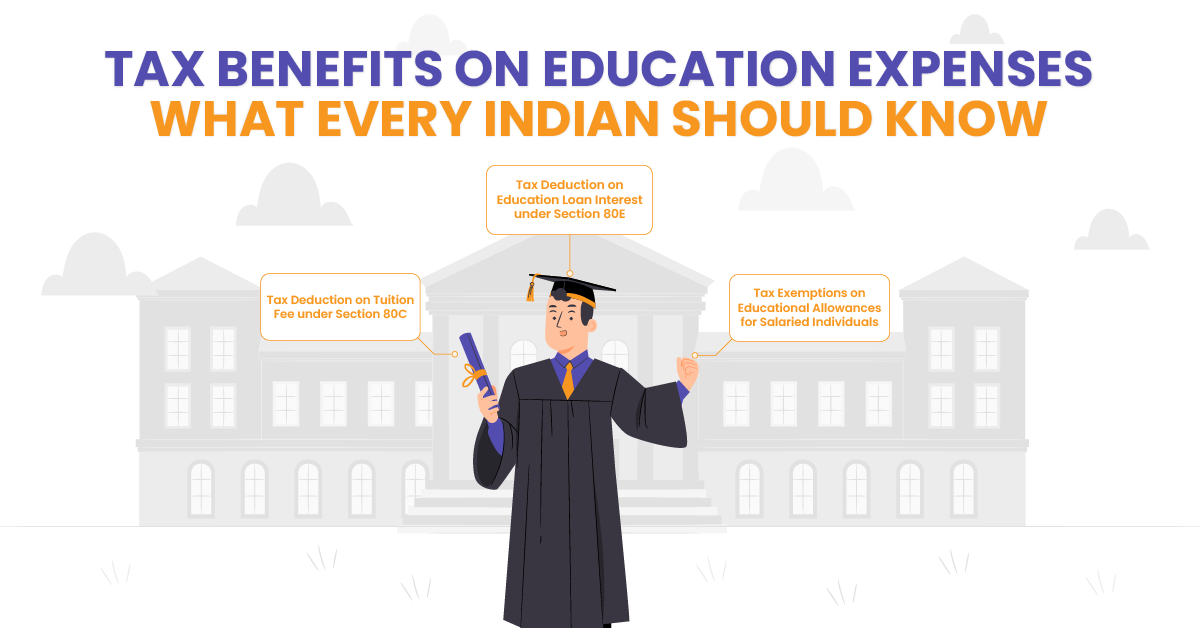
Education can very well be described as the most important aspect of human development and growth. Considering the importance of education in nation building and the financial burden it places, the Government of India provides several tax benefits on education expenses. In this article, let us delve into tax benefits available for Indian taxpayers for the money spent on educating themselves and their families.
Tax Deduction for Tuition Fee under Section 80C
Parents are entitled to benefit from claiming tax deductions on the tuition fees paid for their children’s education under Section 80C of the Income Tax Act, with the below key points to be noted:
- The deduction applies to tuition fee paid to any university, college, school or other educational institution in India. However, such institutions can be private, or Government sponsored.
- This benefit is available for full-time education. Hence, part-time coaching fees or expenses in relation to professional courses are not eligible under this benefit.
- Tuition fees do not include donations, development fees, hostel expenses and similar expenses.
- This deduction, along with other deductions available under section 80C, is capped at ₹1,50,000 in a financial year.
- Benefits can be claimed for up to two children’s education by a parent.
Tax Deduction for Interest on Education Loan under Section 80E
Section 80E of the Income Tax Act allows for a tax deduction for the interest paid on an education loan taken for higher studies. Below are the key provisions covered under this benefit.
- This benefit applies to interest paid on educational loans taken for higher studies. Higher studies here mean, education pursued after passing the Senior Secondary Examination or its equivalent from any school, board or university recognised by the Government or local authorities.
- Loans must be from banks, approved financial institutions or approved charitable institutions.
- Interest on a particular loan is allowed as a deduction for 8 years OR until the clearance of that loan, whichever is earlier.
- This deduction can be claimed not only for the taxpayer’s own education but also for the education of their spouse, children, or any student for whom the taxpayer is a legal guardian.
- Unlike Section 80C, there is no upper limit on the amount that can be claimed under Section 80E, making it a valuable benefit for those financing higher studies through loans.
Tax Exemptions for Educational Allowances under Section 10
Salaried individuals receiving specific allowances from their employers also have got tax benefits by way of exemption to the extent mentioned below:
- Children’s Education Allowance: Exemption of ₹100 per month per child for up to two children.
- Hostel Expenditure Allowance: Exemption of ₹300 per month per child for up to two children.
- Such allowances must be explicitly included in the salary structure by the employer, and valid proof of the expenses must be provided by individuals to avail themselves of exemption benefits.
Note: The above deductions and exemptions are available only under the old regime, not under the new regime.
Conclusion
By availing these benefits, one can effectively reduce taxable income while investing in education for themselves and their family. Awareness of such benefits is crucial for informed financial planning while ensuring tax savings and securing a brighter future.
Contributors:
CA N Srilatha Bhat – LinkedIn
Kuldeep Sarma – LinkedIn
Poonam Vernekar – LinkedIn
Leave a Reply